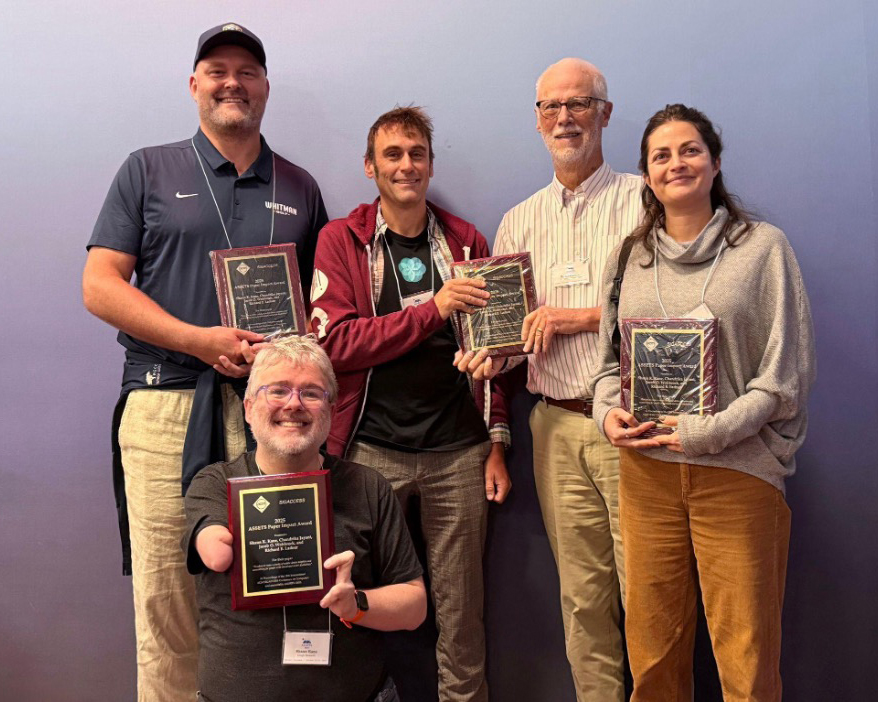
The 2025 SIGACCESS ASSETS Paper Impact Award
By Richard Ladner, AccessComputing Founder
Every two years, ACM SIGACCESS gives the SIGACCESS ASSETS Paper Impact Award to a paper published in the ASSETS Conference from 10 or more years prior “that has had a significant impact on computing and information technology that addresses the needs of persons with disabilities.” This year, at the ASSETS Conference, the SIGACCESS ASSETS Paper Impact Award went to 2009 ASSETS paper “Freedom to roam: a study of mobile device adoption and accessibility for people with visual and motor disabilities,” by Shaun K. Kane, Chandrika Jayant, Jacob O. Wobbrock, and Richard E. Ladner. Wobbrock and Ladner are former Co-PI and PI of AccessComputing, and Shaun Kane, now at Google, was their former co-advised PhD student. Chandricka, now at Be My Eyes, is a former PhD student of Ladner.
What made this paper so important over the past 16+ years is two-fold. First, powerful mobile devices such as smartphones, smartwatches, and others have become standards in society worldwide. Second, the accessibility of these devices has improved over that time as a result of many innovations and studies, many of which can be traced back to this paper. The paper, through its foundational interviews and diary studies, delineated the most important issues around the adoption and use of these devices for blind, low vision, and mobility disabled users. Among these issues are the desired functions of their devices, usage in the world outside of home and office, usage while walking, and coping with device failure. The mobile devices available at the time of the study were not as accessible as they are today, so users had to find ways to get around their inaccessibility, often by getting help from other people.
Among the mobile devices used by participants in the study were not just feature phones, smartphones, and music players, but GPS devices, magnifiers, braille notetakers, and game consoles. Except for braille notetakers, all the functions provided by these extra devices are in today’s smartphones. Now, the Braille notetaker can be replaced by a Bluetooth-compatible and much cheaper Braille input/output device. Participants in the study already seemed to sense that many of the functions they desire–screen reader, speech input, OCR, and music player–could be put into one mobile device, rather than in separate devices. Two of the 19 participants in the study even mentioned user-installable applications, anticipating the iPhone App Store.